

What Should Hospitals Ask a Hospital Bed Manufacturer Before Buying?
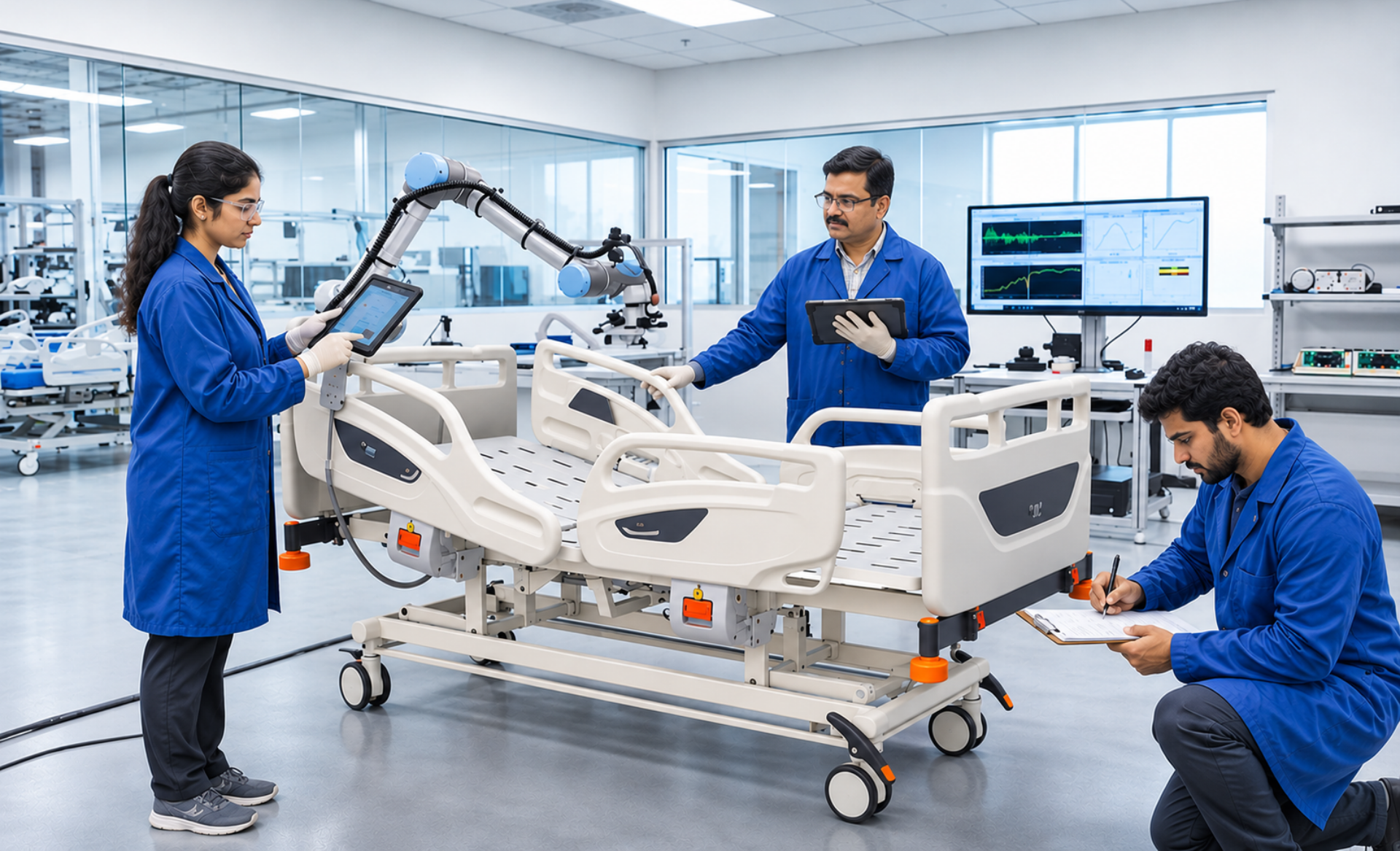
Buying hospital beds is not simply a matter of comparing specifications and prices.
A bed may have the same number of functions as another bed and still be very different in construction, components, usability, service support and long-term ownership.
From a manufacturer’s perspective, we believe hospitals should ask more questions before placing an order.
Not because every question will change the purchase decision, but because the answers tell you a lot about the company standing behind the product.
What Should Hospitals Ask a Hospital Bed Manufacturer Before Buying?
Hospitals should ask a hospital bed manufacturer about manufacturing capability, product construction, materials, applicable standards, testing, customization, warranty, spare parts, service support and delivery capability.
It is also important to understand whether you are buying directly from the manufacturer or through a reseller, and whether the manufacturer can support the beds throughout their working life.
Here are the questions we believe are worth asking.
1. Are You the Manufacturer or a Reseller?
This is one of the first questions worth asking.
A company selling hospital beds is not necessarily the company manufacturing them.
Ask:
- Where is the product manufactured?
- Is the manufacturing facility owned or operated by the company?
- Which parts are manufactured in-house?
- Which components are sourced from other manufacturers?
- Can you arrange a factory visit?
There is nothing wrong with sourcing components or working with manufacturing partners. What matters is being clear about who is responsible for the final product.
For hospitals, this becomes particularly important when customization, quality issues or service requirements arise.
2. Where Are the Hospital Beds Manufactured?
The manufacturing location can tell you something about the company’s ability to control production and provide support.
Ask to see the manufacturing facility if the project is significant.
Look at the actual process:
- Fabrication
- Welding
- Bending
- Assembly
- Surface finishing
- Electrical assembly, where applicable
- Quality inspection
- Final testing
A catalogue can tell you what a bed looks like. A factory can tell you how it is actually made.
3. What Materials and Components Are Used?
Don’t stop at asking whether the bed is “high quality.”
Ask what materials are actually used and where they are used.
Depending on the bed design, this may include:
- Frame materials
- Bed platform materials
- Head and foot boards
- Side rails
- Castors
- Motors
- Control systems
- Actuators
- Other mechanical and electrical components
The important question is not simply whether one material is better than another. It is whether the selected material and component are appropriate for the application.
4. What Standards and Certifications Apply to the Product?
This is an area where hospitals should ask for specifics.
Don’t be satisfied with a general statement such as “the product is certified.”
Ask:
- Which standard applies to this particular product?
- What is the scope of the certification?
- Which model or product family does it cover?
- Is the certificate current?
- Can the relevant documentation be provided?
The applicable requirements can vary depending on the type of medical device and its intended use.
A responsible manufacturer should be able to explain the compliance pathway applicable to the product rather than simply listing certifications in a brochure.
5. How Is the Hospital Bed Tested?
A manufacturer should be able to explain what happens before a bed leaves the factory.
Ask:
- What inspections are carried out during manufacturing?
- What is checked during final assembly?
- Are mechanical functions tested?
- Are electric functions tested on electric beds?
- Are brakes and moving components checked?
- What documentation is maintained for quality inspection?
The exact tests will depend on the product and applicable requirements.
The important thing is that quality should be built into the manufacturing process, not discovered only after delivery.
6. What Functions Does the Hospital Actually Need?
More functions do not automatically mean a better hospital bed.
Before selecting a configuration, discuss where the beds will be used.
For example:
- General wards may have different requirements from ICUs.
- Private rooms may require a different configuration from high-dependency areas.
- Some hospitals may need basic manual adjustment.
- Others may require electric positioning and additional functions.
A good manufacturer should first understand the application and then recommend a suitable configuration.
The right bed is the one that matches the requirement, not necessarily the one with the longest specification sheet.
7. Can the Hospital Bed Be Customized?
Hospitals often have requirements that are different from a standard catalogue configuration.
Ask the manufacturer:
- What can be customized?
- Can dimensions be modified?
- Can accessories or configurations be changed?
- Can the bed be adapted for a particular department?
- What is the minimum quantity for customization?
- How does customization affect delivery time and price?
But customization should have a purpose.
A manufacturer should be willing to say when a requested change is unnecessary or may compromise usability.
Good customization solves a real requirement. It should not simply add features.
8. Can We Inspect and Test the Actual Product?
This is one of the most important questions.
If possible, test the actual model before placing a large order.
Operate the bed.
Move the backrest.
Adjust the height.
Test the side rails.
Move the bed.
Apply the brakes.
Try the controls.
For electric beds, observe the motors and electrical controls.
You can learn a lot about a product in ten minutes of actual use that you may never see in a 20-page brochure.
9. What Warranty Is Provided?
Don’t just ask: “What is the warranty?”
Ask what the warranty actually covers.
For example:
- Frame
- Motors
- Control systems
- Electrical components
- Castors
- Other major components
Also ask: What is excluded? What is the process for making a warranty claim? Who handles the service? How quickly are replacement parts normally arranged?
A warranty is useful only when there is a practical system behind it.
10. Are Spare Parts Available?
This question is often ignored when purchasing new equipment.
A hospital bed may remain in service for years.
Eventually, a component may need replacement.
Ask:
- Which spare parts are normally stocked?
- How long will parts be available?
- Are commonly required components readily replaceable?
- Are replacement parts proprietary or readily serviceable?
- What is the process for ordering them?
The real test of a manufacturer is often what happens several years after the sale.
11. Where Is Your Service Team Located?
Service support matters particularly when a hospital has a large installed base.
Ask:
- Where is the service team located?
- Which regions do you directly cover?
- Do you use authorised service partners?
- What is the normal response time?
- Is preventive maintenance available?
- Who should the hospital contact when there is a problem?
A manufacturer with a strong product but weak after-sales support can create problems for the hospital later.
12. Can You Support Large Hospital Projects?
For a hospital project, purchasing ten beds and purchasing 100 or 300 beds are very different requirements.
Ask about:
- Production capacity
- Delivery schedules
- Batch-wise supply
- Installation requirements
- Project coordination
- Documentation
- Future expansion
A manufacturer should be realistic about production capacity and delivery commitments.
It is better to promise a realistic delivery schedule than to promise everything and struggle to deliver later.
13. What Happens After the Order Is Delivered?
The purchase doesn’t end when the beds arrive.
Ask what the manufacturer provides after delivery.
This may include:
- Installation or commissioning, where applicable
- Product training
- Operating instructions
- Service support
- Preventive maintenance
- Spare parts
- Technical assistance
Understanding this before the purchase avoids confusion later.
Don’t Compare Hospital Beds on Price Alone
Price will always be an important part of a hospital purchase.
But comparing only the purchase price can sometimes create a misleading picture.
Two beds may appear similar on paper but differ in:
- Construction
- Component selection
- Finish
- Usability
- Warranty
- Service support
- Spare-parts availability
- Expected maintenance requirements
Before comparing quotations, make sure you are comparing the same configuration and scope.
Ask what is included in the quoted price.
A lower initial price is not necessarily a lower overall cost if the product requires more maintenance or becomes difficult to service later.
Hospital Bed Manufacturer Evaluation Checklist
Before finalising a manufacturer, hospitals can use this simple checklist:
| What to Ask | What to Understand |
|---|---|
| Are you the manufacturer? | Who is responsible for the product |
| Where is it manufactured? | Manufacturing and quality-control capability |
| What materials are used? | Suitability of construction and components |
| What standards apply? | Applicable compliance requirements |
| How is it tested? | Quality-control process |
| Can it be customized? | Flexibility for project requirements |
| Can we test the product? | Actual usability and build quality |
| What does the warranty cover? | Protection after purchase |
| Are spare parts available? | Long-term serviceability |
| Where is the service team? | After-sales support |
| Can you support project volumes? | Production and delivery capability |
| What happens after delivery? | Installation, training and ongoing support |
What Should You Look for in a Hospital Bed Manufacturer?
A good hospital bed manufacturer should be able to clearly explain how the product is made, why particular materials and components are used, how the product is tested, what standards apply, and how the hospital will be supported after purchase.
The manufacturer should also be willing to discuss limitations honestly.
If every answer is simply “yes,” “best quality,” or “no problem,” ask for more details.
Good manufacturing is usually visible in the details.
Final Thought
A hospital bed is not just another item on a procurement list.
It is equipment that will be moved, cleaned, adjusted, serviced and used every day.
So before comparing one quotation against another, spend some time understanding the product and the company behind it.
Ask questions.
Visit the factory if possible.
Test the actual bed.
Understand the service commitment.
And look beyond the specification sheet.
Because when a hospital buys a bed, it is not just buying the product. It is also choosing the manufacturer who will stand behind it.
Frequently Asked Questions
Common inquiries from healthcare administrators and hospital engineering teams
Planning a Hospital Bed Procurement Project?
Life Medical Systems manufactures customized ward beds, ICU beds, and clinical furniture certified to ISO 13485 standards. Discuss your layout and specifications with our engineering team.