

How to Evaluate Hospital Bed Quality: A Complete Buyer’s Guide
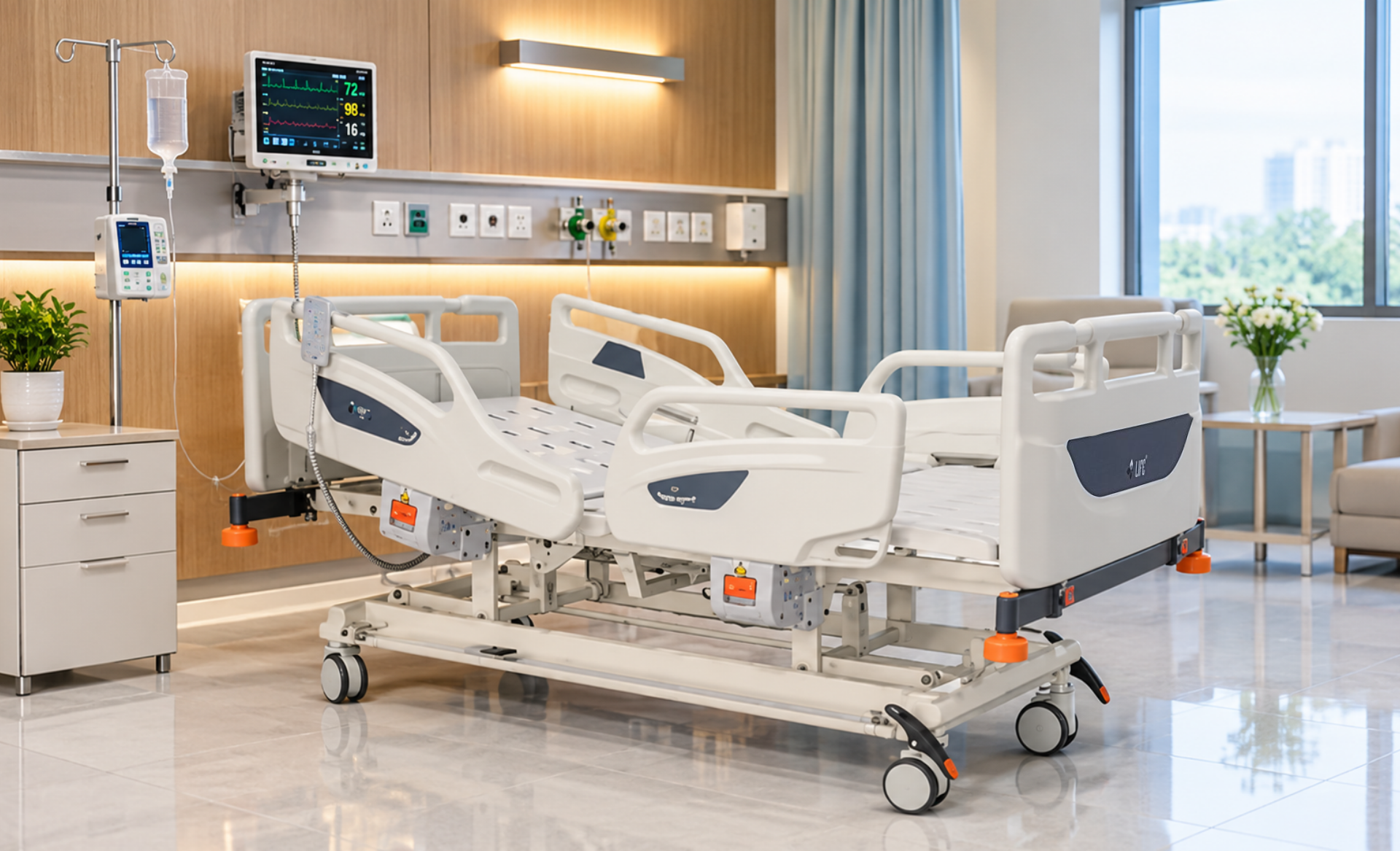
A hospital bed can look impressive in a catalogue and still disappoint in daily use.
The number of functions, polished finish and attractive photographs do not necessarily tell you how well a bed is built or how it will perform after months of regular hospital use.
If you are evaluating hospital beds for a new project, replacement or expansion, it is worth looking beyond the specification sheet.
How Do You Evaluate the Quality of a Hospital Bed?
Hospital bed quality should be evaluated by looking at the complete product, including frame construction, materials, fabrication, surface finish, moving mechanisms, castors and braking, side rails, electrical components, cleanability, serviceability and spare-parts support.
A good hospital bed should also match the intended department, frequency of use and operational requirements of the healthcare facility.
1. Start With the Frame Construction
The frame is the foundation of a hospital bed.
Look at how the main structure is designed, fabricated and supported. A hospital bed is moved, adjusted and used repeatedly, so its construction needs to withstand regular handling throughout its working life.
Do not judge strength only by the thickness of an individual tube or sheet. Overall design, section selection, joints and reinforcement all contribute to structural performance.
When evaluating a bed, check:
- Does the frame feel rigid and stable?
- Are the joints properly fabricated?
- Is there unnecessary movement or looseness?
- Does the bed remain stable when adjusted or moved?
Good engineering is about how the complete structure works together, not simply how heavy the bed is.
2. Look at the Materials Used
Material selection should match the application.
Different parts of a hospital bed may require different materials depending on their function, strength requirements, cleaning requirements and exposure to the hospital environment.
The important question is not simply: “Which material is better?” It is: “Is the material appropriate for the component and its intended use?”
A well-designed bed uses materials where they make the most sense rather than relying on one material throughout the product.
3. Examine Fabrication and Welding Quality
Two hospital beds can use similar materials and still have very different build quality.
Pay attention to welding, bending, joints and finishing details.
Poorly executed fabrication can lead to sharp edges, uneven joints, excessive play in moving components and premature wear.
Look at the actual product rather than relying only on photographs.
The quality of fabrication should be consistent across the bed, including areas that are not immediately visible.
4. Evaluate the Surface Finish and Corrosion Protection
Hospital beds are exposed to frequent cleaning and regular handling.
Surface preparation and coating quality therefore matter for more than appearance.
Look for:
- Consistent surface finish
- Proper surface preparation before coating
- Good coating adhesion
- Smooth and accessible surfaces
- Appropriate corrosion protection
A good finish should support durability and ease of maintenance, not simply make the product look attractive when new.
5. Test the Moving Parts
Hospital beds have several moving components, including backrest sections, knee sections, height adjustment mechanisms and side rails.
Operate them.
Don’t just watch a demonstration.
Check whether the movement is:
- Smooth
- Controlled
- Stable
- Consistent
- Free from excessive play
For electric beds, observe the motors and controls during operation.
For manual beds, check the relevant adjustment mechanisms and operating points.
A specification tells you what a bed can do. Testing tells you how well it does it.
6. Check the Castors and Braking System
Castors are easy to overlook when evaluating a hospital bed, but they have a direct impact on everyday use.
Check how easily the bed moves, how it behaves while turning and how securely it stays in position when the brakes are applied.
Also consider the hospital’s flooring and how frequently the beds will be moved.
A bed that looks excellent but is difficult to manoeuvre or does not brake effectively can become a practical problem for hospital staff.
7. Evaluate the Side Rails
Side rails are another component where design and build quality matter.
Check:
- How easily they operate
- Whether they lock securely
- Whether they remain stable when raised
- Whether the mechanism feels robust
- Whether staff can operate them without unnecessary effort
The important question is not simply whether a hospital bed has side rails. It is how well those side rails work in everyday use.
8. For Electric Beds, Evaluate the Electrical System
For an electric hospital bed, the electrical system is an important part of the overall product.
Look beyond the number of motors or functions.
Consider:
- Motor performance
- Handset and control arrangement
- Nurse-control options where applicable
- Cable management
- Protection of electrical components
- Emergency or backup arrangements where applicable
- Availability of replacement components
The electrical system should be reliable and practical for the hospital’s actual usage.
9. Consider Cleaning and Maintenance
Hospital beds are cleaned frequently, so the design should make routine cleaning practical.
Look for areas where dirt, moisture or cleaning residue could accumulate unnecessarily.
Smooth, accessible surfaces and thoughtful component placement can make routine cleaning and maintenance easier.
This is an area where a product can look excellent in a showroom but reveal practical weaknesses after months of hospital use.
10. Ask About Serviceability and Spare Parts
This is one of the most overlooked areas when purchasing hospital beds.
A hospital bed is a long-term working asset. Components may eventually require adjustment, replacement or servicing.
Before purchasing, ask:
- Are spare parts readily available?
- How long will commonly required parts be supported?
- Who provides service?
- Where is the service team located?
- What is the expected response time?
- Can routine maintenance be carried out easily?
A lower purchase price may not remain attractive if obtaining a simple replacement component becomes difficult later.
11. Don’t Judge a Hospital Bed From Photographs Alone
Photographs are useful for understanding design. They are not enough to evaluate quality.
Whenever possible, inspect the actual product.
Operate the bed. Move it. Apply the brakes. Raise and lower the side rails. Test the controls. Look underneath the bed. Examine the joints, moving mechanisms and finish.
The best time to discover a weakness is before the purchase, not after the bed reaches the hospital.
Hospital Bed Quality Checklist
Use this comprehensive checklist to compare hospital beds across every essential engineering parameter:
| What to Check | Why It Matters |
|---|---|
| Frame construction | Structural stability and durability |
| Material selection | Suitability for the intended application |
| Fabrication quality | Consistency and build quality |
| Surface finish | Cleaning and corrosion protection |
| Moving mechanisms | Smooth and reliable operation |
| Castors | Mobility and manoeuvrability |
| Braking system | Stability when stationary |
| Side rails | Practical and secure operation |
| Electrical system | Reliability in electric beds |
| Cleanability | Easier routine maintenance |
| Spare parts | Long-term serviceability |
| Manufacturer support | After-sales reliability |
What Should You Check Before Buying a Hospital Bed?
Before purchasing a hospital bed, consider these ten points:
- 1Identify where the bed will be used.
- 2Determine the functions actually required.
- 3Inspect the frame and fabrication.
- 4Check the materials used.
- 5Test the moving mechanisms.
- 6Check castors and braking.
- 7Examine the side rails.
- 8For electric beds, evaluate motors and controls.
- 9Assess cleaning and maintenance requirements.
- 10Ask about spare parts and after-sales service.
Most importantly, test the actual product whenever possible rather than making a decision based only on a brochure or specification sheet.
What Makes a Good Quality Hospital Bed?
A good quality hospital bed combines sound construction, appropriate materials, reliable mechanisms, practical mobility, suitable safety features, easy maintenance and dependable after-sales support.
There is no single feature that determines quality. It is the way all these elements work together for the intended application.
A bed designed for an ICU may have different requirements from one intended for a general ward or private room.
Quality Is More Than a Specification Sheet
A specification sheet tells you dimensions, functions, materials and other defined characteristics.
But quality is also reflected in things that are harder to capture in a table.
How stable does the bed feel? How smoothly does it operate? How well are the components assembled? How easy is it to clean? What happens when something needs to be serviced?
These questions become important once the bed enters daily hospital use.
Final Thought
A good hospital bed isn’t simply one with more features.
It is one that is thoughtfully engineered, properly manufactured and reliable in the environment where it will actually be used.
When evaluating a hospital bed, look beyond the brochure. Look at how it is built, how it works and how it will be supported over time.
Frequently Asked Questions
Common inquiries from healthcare administrators and hospital engineering teams
Planning a Hospital Bed Procurement Project?
Life Medical Systems manufactures customized ward beds, ICU beds, and clinical furniture certified to ISO 13485 standards. Discuss your layout and specifications with our engineering team.