

Hospital Bed Features: Which Ones Actually Matter?
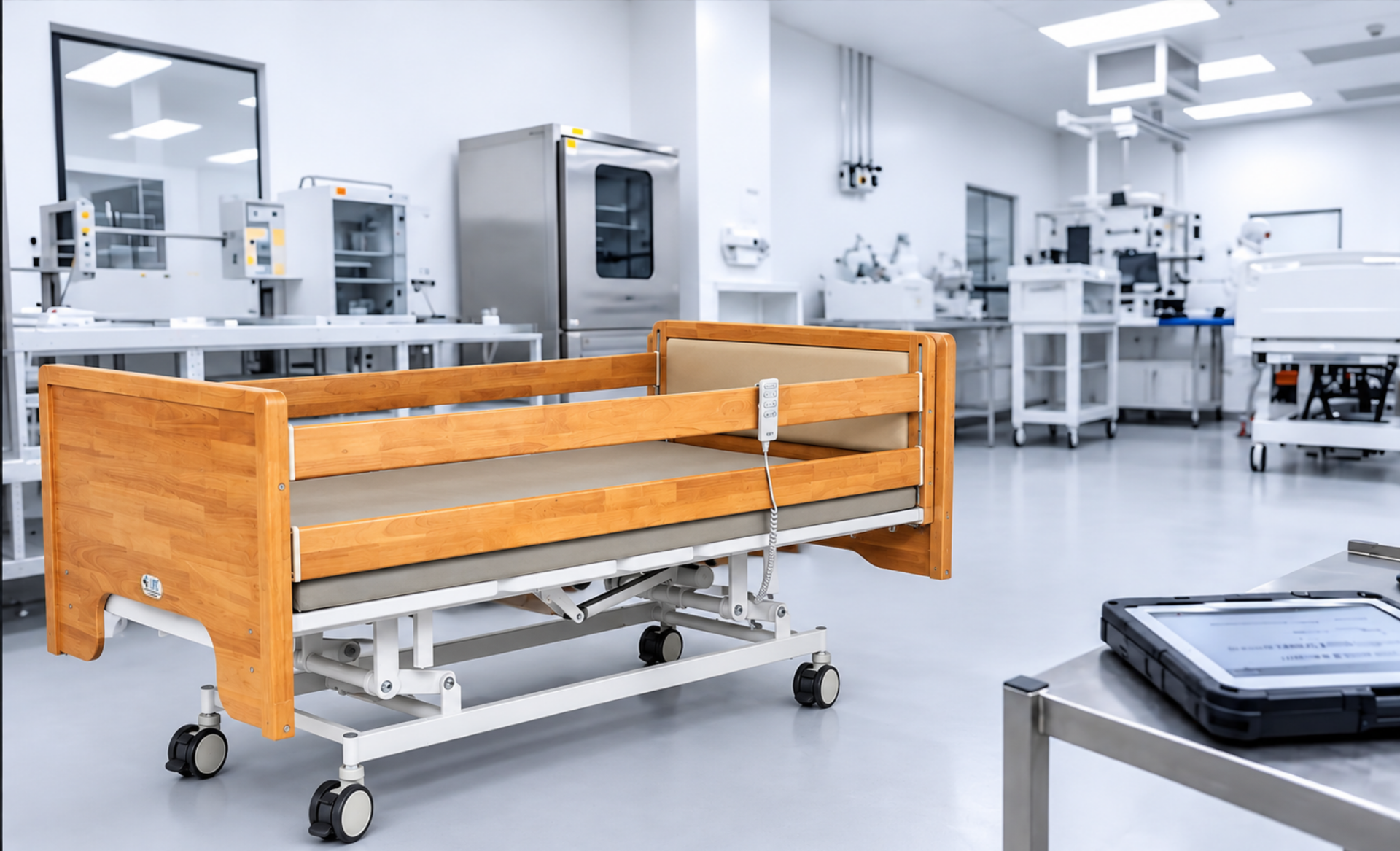
Choosing a hospital bed is not simply about looking at the number of functions or comparing specifications.
The details around those functions can have a significant impact on how easily the bed is operated, how comfortably it can be used by patients and hospital staff, and how well it fits the requirements of a particular department.
A hospital bed may include features such as different control options, CPR mechanisms, side rails, castors, central locking, bed extension and X-ray compatibility. But not every feature is necessary for every application.
The right approach is to understand what each feature does, who uses it and whether it is genuinely required for the intended application.
Here are the hospital bed features that are worth evaluating.
1. Manual Bed Controls
Manual hospital beds are operated using a mechanical crank mechanism. The handle is connected to a crank rod, which transfers the movement to the corresponding mechanism of the bed.
Although the operating principle is straightforward, the quality of the manual control system matters considerably.
A well-designed manual mechanism should allow hospital staff to operate the bed without unnecessary effort. The crank handle should be comfortable to use, the mechanism should operate smoothly, and the crank rod and its connections should be designed to withstand repeated operation.
The position of the crank also matters. It should be accessible when required and should not create an unnecessary obstruction when not being used.
When evaluating a manual hospital bed, look at:
- Crank handle design
- Smoothness of operation
- Crank mechanism
- Crank rod construction
- Operating effort
- Handle position
- Protection or storage of the crank when not in use
Manual does not necessarily mean basic. A well-engineered manual operating mechanism can make a significant difference to everyday usability.
2. Electric Bed Controls
Electric hospital beds can be operated through different control arrangements depending on the design of the bed and the people who need access to it.
The most common options are: Handset / Patient Remote, Nurse Control Remote, and Embedded Controls.
The right configuration depends on the hospital's requirements and on which functions need to be accessible to the patient and which should remain under the control of hospital staff.
Handset / Patient Remote: A patient handset allows the patient to operate the functions assigned to them. The control should be simple and easy to understand, particularly for patients who may be unfamiliar with the bed. Important considerations include clear and identifiable buttons, logical button arrangement, easy access from the patient's position, suitable cable length, cable management, durable construction, and ease of cleaning.
Nurse Control Remote: A nurse control remote is designed for hospital staff, generally providing access to a wider range of bed functions required during patient care. For nurses, the control should be easy to identify and operate quickly. Considerations include clear identification of controls, logical arrangement, convenient accessibility, cable management, durability, ease of cleaning, and appropriate access to bed functions.
Embedded Controls: Embedded controls are integrated into the bed itself, commonly within the side-rail system. This keeps the controls as part of the bed rather than leaving a separate remote that needs to be handled and stored. Important considerations include visibility, accessibility, clear identification, integration with the side rail, protection against accidental operation, ease of cleaning, and durability.
3. Manual CPR
A manual CPR release allows the mattress platform to be quickly brought to the required emergency position through a mechanical release.
In an emergency, the value of this feature depends heavily on how easily hospital staff can locate and operate it. The release mechanism should be:
- Easily accessible
- Simple to operate
- Clearly identifiable
- Mechanically reliable
- Robust enough for repeated use
- Easy to reset after operation
A CPR feature should not be complicated simply for the sake of adding functionality. In an emergency, simplicity matters.
4. Electric CPR and Zero Function
Electric hospital beds can incorporate CPR positioning into their electrical control system.
An electric CPR function allows the required positioning to be initiated through the bed's electrical controls, depending on the specific design.
A Zero Function is generally used to return the mattress platform to a predefined flat or zero position.
These features can be particularly relevant in applications where rapid and controlled positioning of the bed is important. When evaluating them, consider:
- Ease of operation
- Accessibility for authorised staff
- Clear identification
- Reliability
- Integration with the overall control system
- Availability of appropriate emergency/manual operation where required by the design
The exact operation of CPR and Zero Function can vary between hospital-bed designs, so hospitals should evaluate the actual mechanism rather than relying only on the feature name in a specification sheet.
5. X-Ray Compatible Top with Cassette Holder
For hospitals where bedside X-ray imaging is required, an X-ray compatible mattress platform with a cassette holder can allow imaging to be performed without unnecessarily transferring the patient to another surface.
The cassette holder should allow the X-ray cassette to be positioned correctly beneath the patient and removed conveniently after imaging. The complete system should provide:
- X-ray-compatible mattress platform
- Properly integrated cassette holder
- Easy cassette insertion and removal
- Adequate access beneath the patient
- Stable cassette positioning
- Sufficient clearance for the intended imaging application
- Minimal interference from other bed components
This feature can be particularly useful in ICU, emergency and critical-care applications, where moving a patient for imaging may not always be practical. The important point is to evaluate the X-ray-compatible top and cassette holder as one integrated feature, rather than considering them separately.
6. Bed Extension
A bed extension allows the mattress platform to be extended to accommodate patients of different heights.
This can provide additional flexibility where a standard mattress-platform length may not be suitable for every patient. A well-designed bed extension should be:
- Easy for hospital staff to operate
- Secure when extended
- Properly integrated with the mattress platform
- Compatible with the intended mattress
- Convenient to use during routine patient care
The extension should also work properly with the overall bed configuration rather than functioning as an isolated add-on.
7. Side Rails
Side rails are an important part of the hospital-bed configuration and can serve different purposes depending on their design and the intended application.
Hospital beds may use different side-rail configurations, including full-length or split designs. When evaluating side rails, consider:
- Strength and rigidity
- Ease of raising and lowering
- Locking mechanism
- Patient accessibility
- Positioning and clearance
- Ease of cleaning
- Integration with the bed and mattress platform
A side rail should be practical for both the patient and hospital staff.
It should be easy to operate when required and should not make routine patient-care activities unnecessarily difficult.
8. Castors
Castors directly affect how easily a hospital bed can be moved and positioned.
However, castor performance depends on more than wheel size. The castor body, wheel material, swivel mechanism, load capacity and braking arrangement all contribute to how the bed performs.
Depending on the product design, hospital beds may use combinations such as nylon-bodied castors with TPE tread. When evaluating castors, consider:
- Castor construction
- Wheel material
- Smooth movement
- Swivel performance
- Appropriate load capacity
- Braking system
- Durability
- Ease of operation
9. Central Locking / Central Braking
A central locking or central braking system allows hospital staff to control the bed's castors through a central mechanism.
Instead of operating each castor individually, the central system can make it easier to switch the bed between its mobile and locked positions.
This can be particularly useful when hospital staff need to reposition beds frequently. Important considerations include:
- Ease of operation
- Accessibility of the central brake
- Reliable locking
- Stability when locked
- Smooth transition between locked and unlocked positions
- Integration with the castor system
The braking system should be simple enough to operate quickly and reliably during routine hospital work.
10. Mattress Platform & Mattress Compatibility
The mattress platform is an important part of the overall bed configuration because it needs to work correctly with the mattress being used.
The relationship between the bed platform and mattress affects the overall usability of the bed, particularly when the mattress platform is designed to move or extend. Hospitals should consider:
- Mattress dimensions
- Platform dimensions
- Mattress compatibility
- Platform configuration
- Mattress retention
- Compatibility with bed extension, where applicable
- Compatibility with the intended bed positioning
A hospital bed and mattress should be considered as a working combination, rather than two completely independent products.
Which Hospital Bed Features Actually Matter?
There is no universal list of features that is right for every hospital.
A general ward may require a relatively simple configuration. An ICU may require additional emergency and imaging-related features. A nursing home or long-term-care facility may have different priorities.
The right question is therefore not: "How many features does this hospital bed have?" Instead, ask:
- Who will use the bed?
- Which features are actually required?
- How frequently will they be used?
- Are the controls easy to operate?
- Are emergency features easy to access?
- Is the bed easy to move and secure?
- Does it accommodate the required mattress?
- Is X-ray compatibility required?
- Is a bed extension useful for the intended patient population?
A hospital bed should be configured around the actual requirements of the application.
More Features Do Not Automatically Mean a Better Hospital Bed
It is easy to compare hospital beds by counting functions, controls and accessories.
But more does not automatically mean better.
A bed with a long specification may not necessarily be more practical than a simpler bed with the features that the hospital actually needs.
For example, a hospital may benefit more from a well-designed control system, reliable CPR operation, practical side rails, good castor and braking performance, and appropriate mattress compatibility than from several additional features that are rarely used.
The objective should always be to achieve the right balance between functionality, usability and application requirements.
How Should Hospitals Evaluate Hospital Bed Features?
Before purchasing, hospitals should evaluate the physical product rather than relying only on photographs or a specification sheet.
Where possible, ask for a demonstration and consider:
- 1Operation: Can nurses operate the controls easily?
- 2Patient Access: Can the patient comfortably access the functions intended for them?
- 3Emergency Use: Can CPR-related features be located and operated quickly?
- 4Mobility: Can hospital staff move and secure the bed without unnecessary effort?
- 5Imaging: If bedside X-ray is required, does the X-ray system work practically with the hospital's imaging workflow?
- 6Mattress: Is the proposed mattress compatible with the bed platform and configuration?
- 7Daily Use: Do the features actually make routine patient care easier?
The best way to evaluate a hospital bed is to use it as hospital staff would use it.
The Right Features Are the Ones That Work in Real Hospitals
Hospital beds are used every day, often repeatedly and in demanding situations.
That is why features should not be selected simply because they appear impressive on a specification sheet.
A manual crank should operate smoothly. Electric controls should be intuitive. CPR mechanisms should be accessible. X-ray compatibility should work practically. Side rails should be easy to operate. Castors should move smoothly and lock securely.
Every feature should have a purpose.
Good hospital-bed design is not about adding everything possible. It is about understanding what really needs to be there—and designing it properly for real hospital use.
Frequently Asked Questions
Common inquiries from healthcare administrators and hospital engineering teams
About Life Medical Systems
Life Medical Systems is an Indian healthcare equipment company focused on hospital furniture and patient-care solutions.
Our experience has taught us that a good hospital bed is not simply a collection of features. It is the result of understanding how the product will actually be used and making the right decisions about its design, materials, engineering and manufacturing.
We believe good healthcare equipment should be practical, dependable and built around real hospital requirements.
Planning a Hospital Bed Procurement Project?
Life Medical Systems manufactures customized ward beds, ICU beds, and clinical furniture certified to ISO 13485 standards. Discuss your layout and specifications with our engineering team.