

What Are the Different Types of Hospital Beds?
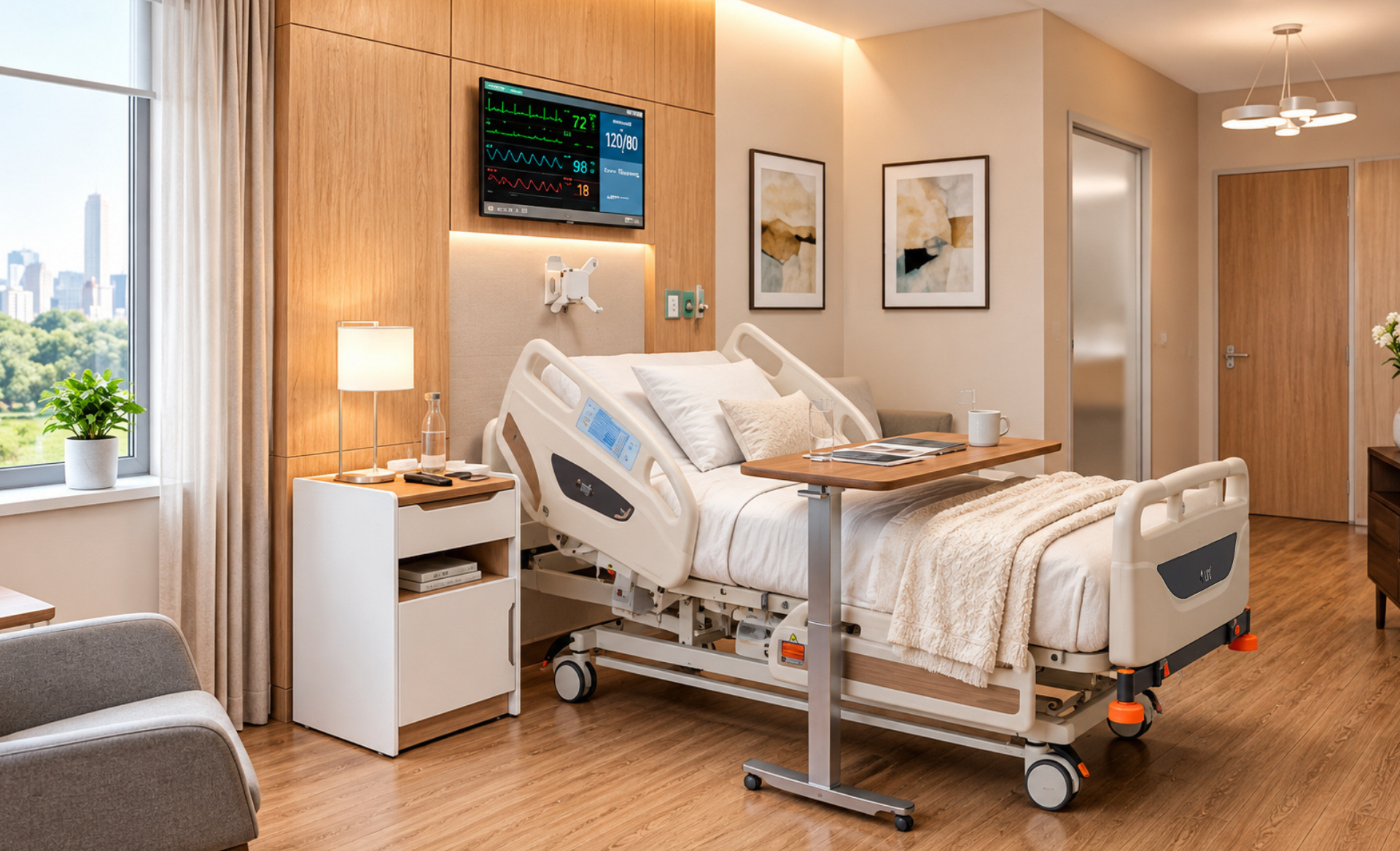
When hospitals compare hospital beds, the terminology can sometimes be confusing.
You may come across terms such as Semi-Fowler, Fowler, three-function, five-function, manual, electric, semi-electric and electro-mechanical beds. These terms do not all describe the same thing.
Some describe the functions of the bed, while others describe how those functions are operated.
Understanding this difference is important when selecting hospital beds because the right configuration depends on where the bed will be used, what functions are required and how the hospital staff will operate it.
Different Types of Hospital Beds at a Glance
A quick summary of standard hospital bed types categorized by their primary articulation capabilities:
These functions may be operated manually, electrically or through a combination of mechanisms, depending on the bed configuration.
| Hospital Bed Type | Typical Functions |
|---|---|
| Semi-Fowler / Single Function | Backrest / Head-up |
| Fowler / Two Function | Backrest / Head-up + Knee / Leg-up |
| Three Function | Backrest / Head-up + Knee / Leg-up + Height |
| Five Function | Backrest / Head-up + Knee / Leg-up + Height + Trendelenburg + Reverse Trendelenburg |
Manual Hospital Beds & Electric Hospital Beds
Manual and electric hospital beds can provide the same types of functions. The main difference is how those functions are operated.
In a manual hospital bed, the required adjustments are operated manually, while electric hospital beds use electric motors and controls to operate the required functions.
Depending on the model, a hospital bed can provide:
- Backrest / Head-up
- Knee / Leg-up
- Height adjustment
- Trendelenburg
- Reverse Trendelenburg
The exact combination depends on the particular model.
The choice between a manual and electric bed depends on the requirements of the hospital, the department where the bed will be used and how the hospital staff prefer to operate the bed.
An electric bed is therefore not necessarily a different set of functions. It is another way of operating the required functions.
Semi-Electric Hospital Beds
Semi-electric hospital beds combine manual and electric operation.
Some functions are electrically operated, while others are adjusted manually. The exact combination depends on the design of the bed.
This configuration can be considered when a hospital requires electric operation for certain functions while retaining manual operation for others.
When comparing semi-electric beds, it is important to check exactly which functions are electrically operated and which require manual adjustment.
Electro-Mechanical Hospital Beds
Electro-mechanical hospital beds can be designed to provide both electric and manual operation of the bed functions, depending on the product configuration.
This type of design can provide flexibility in how the bed is operated.
The exact functions and operating mechanism should always be checked against the manufacturer's specifications, as configurations can vary between models.
Hospital Beds Based on Number of Functions
Another common way of describing hospital beds is by the number of functions they provide. You may see terms such as:
- Single-function hospital bed
- Two-function hospital bed
- Three-function hospital bed
- Five-function hospital bed
These terms describe the functions provided by the bed, not necessarily whether the bed is manual or electric.
Single-Function Hospital Beds — Semi-Fowler
A Semi-Fowler hospital bed can be configured as a single-function hospital bed, with the primary function being Backrest / Head-up adjustment.
The backrest allows the patient's upper body to be raised from the flat position.
Depending on the model, this function can be operated manually or electrically.
A single-function Semi-Fowler bed can be suitable where basic patient positioning is required without the need for additional bed adjustments.
Two-Function Hospital Beds — Fowler
A Fowler hospital bed can be configured as a two-function hospital bed, providing:
- 1Backrest / Head-up
- 2Knee / Leg-up
These two adjustments allow the upper body and leg sections of the bed to be positioned according to the requirement.
Two-function Fowler beds can be available with different operating mechanisms, including manual and electric configurations, depending on the model.
Three-Function Hospital Beds
A three-function hospital bed typically provides:
- 1Backrest / Head-up
- 2Knee / Leg-up
- 3Height adjustment
Height adjustment allows the complete bed platform to be raised or lowered.
Three-function hospital beds can be used in different hospital departments depending on the requirements.
They may also be considered for certain ICU and critical-care applications, depending on the complete specification and configuration required by the hospital.
The number of functions alone should not determine whether a bed is suitable for a particular department. The overall design, construction, safety features and required accessories also need to be considered.
Five-Function Hospital Beds
A five-function hospital bed typically provides:
- 1Backrest / Head-up
- 2Knee / Leg-up
- 3Height adjustment
- 4Trendelenburg
- 5Reverse Trendelenburg
The additional positioning functions provide greater flexibility when the bed needs to be positioned for different clinical requirements.
Five-function hospital beds can be used in different applications, including ICU and critical-care environments, depending on the overall design and specification.
It is important to understand that "five-function" and "ICU bed" do not mean exactly the same thing.
Five-function describes the number of primary functions provided by the bed, while an ICU bed is designed around the requirements of critical care.
Therefore, when selecting a five-function ICU bed, hospitals should consider the complete product specification rather than choosing a bed based only on the number of functions.
Understanding the Main Hospital Bed Functions
The terminology becomes easier to understand when the individual functions are considered separately:
- Backrest / Head-up: Raises the back section of the mattress platform to position the patient's upper body.
- Knee / Leg-up: Raises the knee or leg section of the mattress platform.
- Height Adjustment: Raises or lowers the complete bed platform for caregiver ergonomic comfort and patient ingress/egress.
- Trendelenburg: Tilts the bed so that the head side is lower than the foot side.
- Reverse Trendelenburg: Tilts the bed so that the head side is higher than the foot side.
These functions can be combined in different ways to create different hospital bed configurations.
What About Side Rails, Castors and Other Accessories?
Side rails, castors and other accessories are separate from the number of functions of a hospital bed.
They form part of the overall bed configuration and can vary depending on the model and the hospital's requirements. Depending on the bed, hospitals may consider accessories such as:
- Side rails
- IV pole
- Oxygen cylinder holder
- Urine bag holder
- Mattress
- Over-bed table
- Other patient-care accessories
For example, side rails can differ in design and operation, while castors can differ in size, construction, braking and mobility characteristics.
These details can have an important effect on everyday use, but they do not determine whether a bed is a one-, two-, three- or five-function bed.
How Should Hospitals Choose the Right Hospital Bed?
There is no single type of hospital bed that is right for every hospital. The starting point should be the actual requirement. A hospital should consider:
- Where will the bed be used? A general ward, ICU, nursing home or other department may have different requirements.
- Which functions are required? Not every application needs the same range of adjustments.
- How should the functions be operated? The hospital may prefer manual, electric, semi-electric or electro-mechanical operation depending on the application.
- What configuration is required? Side rails, castors and other accessories should be selected according to the intended use.
- What does the hospital staff need? The bed should be practical for the nurses and hospital staff who will use it every day.
- What about maintenance and service? Availability of spare parts, technical support and service should also be considered when selecting a bed.
Looking at these factors together gives a much clearer picture than simply comparing the number of functions.
A Simple Way to Understand Hospital Bed Types
The terminology becomes easier if you separate the three things being described:
1. Bed configuration and functions: Semi-Fowler (Single function), Fowler (Two function), Three-function bed, Five-function bed.
2. Operating mechanism: Manual, Electric, Semi-electric, Electro-mechanical.
3. Accessories and configuration: Side rails, Castors, IV pole, Oxygen cylinder holder, Mattress, Other accessories.
These categories can overlap. For example, a three-function hospital bed can be manual or electric. Similarly, a five-function hospital bed can be available in different operating configurations. This is why the product specification needs to be understood as a whole.
Choosing the Right Hospital Bed
The right hospital bed is not simply the one with the highest number of functions.
It is the bed whose functions, operating mechanism and configuration match the actual requirement of the hospital.
A Semi-Fowler bed may be sufficient where only backrest adjustment is required.
A Fowler bed can provide both backrest and knee adjustment.
A three-function bed adds height adjustment.
A five-function bed adds Trendelenburg and reverse Trendelenburg.
The same types of functions can be operated through manual or electric mechanisms, while semi-electric and electro-mechanical configurations provide other combinations of operation.
At Life Medical Systems, we believe hospital bed selection should start with understanding the requirement rather than selecting a product based only on a specification list.
Frequently Asked Questions
Common inquiries from healthcare administrators and hospital engineering teams
About Life Medical Systems
Life Medical Systems is an Indian healthcare equipment company focused on hospital furniture and patient-care solutions.
Our experience has taught us that a good hospital bed is not simply a collection of features. It is the result of understanding how the product will actually be used and making the right decisions about its design, materials, engineering and manufacturing.
We believe good healthcare equipment should be practical, dependable and built around real hospital requirements.
Planning a Hospital Bed Procurement Project?
Life Medical Systems manufactures customized ward beds, ICU beds, and clinical furniture certified to ISO 13485 standards. Discuss your layout and specifications with our engineering team.