

How to Choose the Right Hospital Bed for Your Healthcare Facility
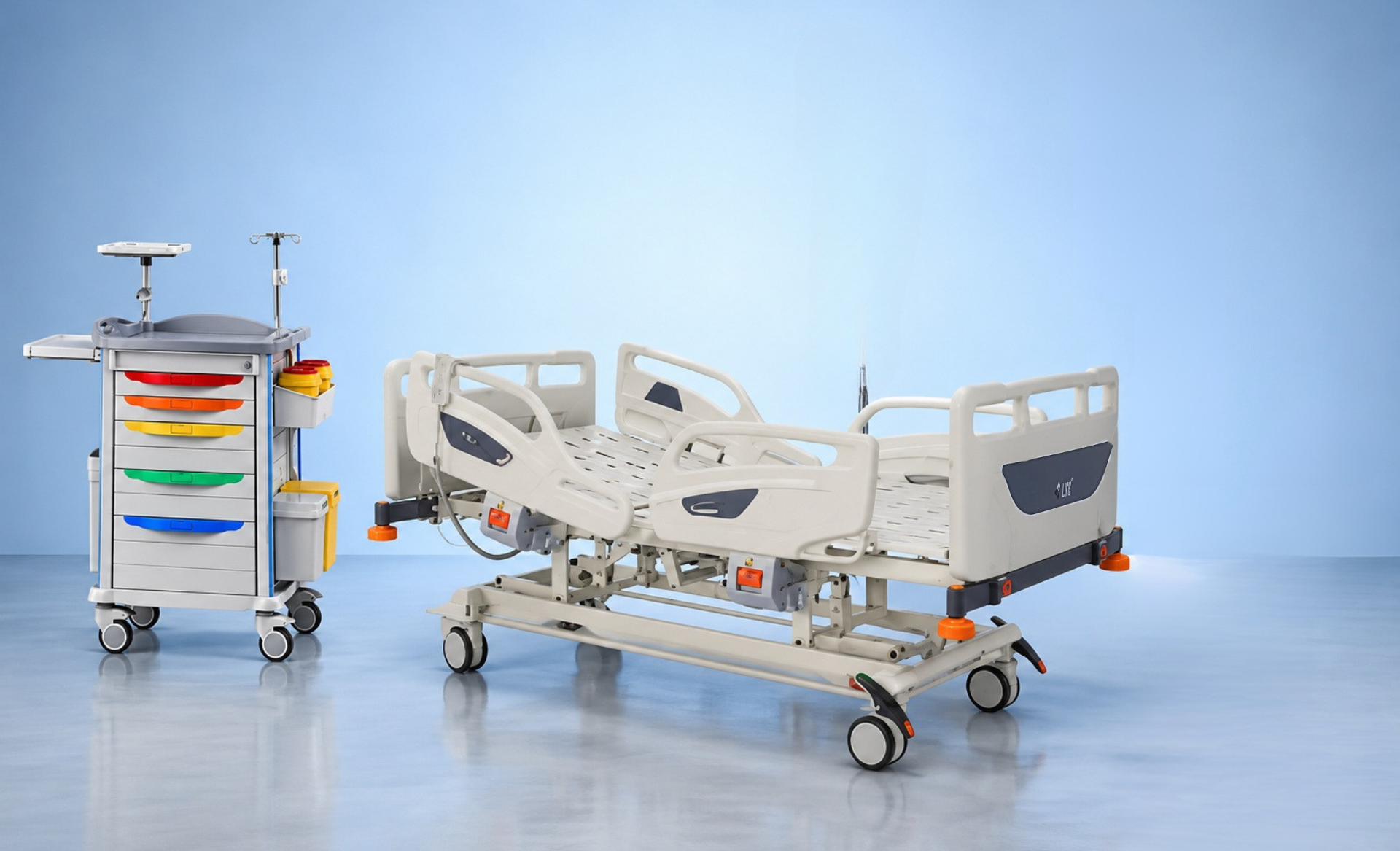
When a hospital is looking for new beds, the comparison often starts with three things: price, specifications and features.
All three matter. But after years of working with hospital furniture, we have found that a good hospital bed cannot be judged from a specification sheet alone.
How will the bed actually be used? Which functions are really needed? Does the size work for the room? How well is the structure engineered? What materials are being used? And how easy will the bed be to maintain after years of daily use?
These questions often matter more than simply choosing the model with the longest list of features.
Here are some of the things we believe hospitals should look at when selecting a hospital bed.
1. Start With Where the Bed Will Be Used
A hospital bed for a general ward may have very different requirements from one used in an ICU, post-operative ward, rehabilitation centre or nursing home.
Before looking at specific models, understand how the bed will be used. For example:
- What type of patients will use it?
- How often will the patient's position need to be changed?
- How much assistance will nurses or caregivers provide?
- Will the bed need to be moved frequently?
- How much space is available around the bed?
- What accessories will be required?
Starting with these questions makes it easier to identify the right type of hospital bed rather than choosing a product first and trying to fit it to the requirement later.
2. More Functions Don't Always Mean a Better Bed
This is something we have seen quite often.
A hospital may ask for additional functions simply because they are available. Sometimes those functions are genuinely useful. But sometimes they may not be needed for the way the bed will actually be used.
Every additional function can mean additional components, controls, complexity and cost.
Depending on the model and requirement, hospital beds may have functions such as:
- Backrest adjustment
- Knee or leg adjustment
- Height adjustment
- Trendelenburg and reverse Trendelenburg
- CPR-related functions
- Patient controls
- Nurse controls
- Different side-rail configurations
3. Standard Size Is Not Always the Right Size
Most hospital beds are available in standard dimensions, and these work well for many hospitals.
But every hospital does not have the same rooms, corridors or requirements.
Certain areas may need a different length, width or configuration because of the available space, patient requirements or the way staff work around the bed.
This is where customization can make sense.
A customized hospital bed should solve a genuine requirement—not simply be different from a standard model.
The important thing is to first understand the requirement and then determine what needs to change.
4. Don't Judge a Hospital Bed Only by Its Photograph
This is particularly important when comparing products online.
Two hospital beds can look almost identical in a photograph and still be very different products.
A photograph cannot tell you everything about:
- The materials used
- The construction of the frame
- How joints are designed
- The quality of the castors
- The materials used in the castors
- Surface treatment
- How easily the product can be maintained
For example, we use materials such as HDPP for selected head and foot board applications and nylon-bodied castors with TPE tread, depending on the product and its requirements.
These details may not be obvious in a brochure or photograph.
This is why, especially for larger hospital projects, we believe it is valuable to see and operate the actual product before making a decision.
Sometimes, you need to see, touch and use a product to really understand its quality.
5. A Strong Hospital Bed Is About Engineering, Not Just Thickness
When people talk about the strength of a hospital bed, it is easy to assume that thicker sheets or larger tubes automatically mean a stronger product.
Material thickness and tube dimensions are certainly important.
But they are only part of the story.
The way the frame is designed, how the joints are made, where the loads are distributed and how the different components work together all contribute to the strength and reliability of the bed.
In other words, good engineering is not simply about using more material.
It is about using the right material in the right place and designing the structure properly for the loads and conditions it will experience.
This is one reason why two beds can look similar on the outside and still perform very differently in actual use.
6. The Finish and Metal Treatment Matter Too
The metal structure of a hospital bed has to withstand regular cleaning and everyday use. So the surface treatment is more than just about appearance.
A durable powder-coated finish starts with proper preparation of the metal underneath it.
In our manufacturing process, we use rust-prevention treatment before powder coating to help protect the metal structure against corrosion and support the long-term life of the product.
This part of the process may not be visible once the bed is finished, but it matters to how the product holds up over time.
For us, product life is built into the process—not added at the end.
7. Think About the Patient and the Caregiver
A hospital bed has to work for both the patient and the person looking after them.
For the patient, positioning, accessibility and appropriate side-rail design are important.
For nurses and caregivers, the bed needs to be practical during everyday work.
Think about how easily they can:
- Adjust the bed
- Position the patient
- Move the patient
- Carry out bedside procedures
- Move the bed when required
- Clean the bed
Controls should also be straightforward for the people who are expected to use them.
A bed can have many functions, but if those functions make everyday use unnecessarily complicated, more features may not mean more value.
8. Pay Attention to Mobility
Hospital beds are moved more often than many people realize.
They may be moved within a patient room, through corridors or between departments.
That makes the castors and braking system important parts of the product.
Look at:
- Castor construction
- Castor size
- Braking system
- Ease of pushing and steering
- Stability when stationary
- How the bed moves on the hospital's floors
These may seem like small details when reading a specification sheet. In daily hospital use, they are not small details.
9. Consider Cleaning, Maintenance and Service
A hospital bed needs regular cleaning, so the design should make cleaning practical.
It is worth looking at areas that may be difficult to reach, the accessibility of components and the overall surface finish.
Maintenance is equally important.
Before buying, ask about:
- Warranty
- Spare parts
- Service support
- Replacement components
- Maintenance requirements
- Technical assistance
A hospital bed is expected to remain in service for years.
So the question should not only be: “What does the bed cost today?” It should also be: “What will it cost to own and maintain over its working life?”
10. Look at the Manufacturer, Not Just the Product
Two hospital beds can have similar specifications and still be very different in engineering, construction and long-term performance.
The difference can come from material selection, manufacturing processes, quality checks, serviceability and the support available after the sale.
When evaluating a hospital bed manufacturer, ask:
- Does the manufacturer understand the requirement?
- Can they provide customization when genuinely needed?
- What materials and components are being used?
- How is the product manufactured and checked?
- Are spare parts available?
- What service support is provided?
- Can they support the product over its working life?
For a hospital, the relationship with the manufacturer does not end when the beds are delivered.
A Practical Hospital Bed Selection Checklist
Before making a decision, review each of these foundational evaluation parameters:
| Evaluation Parameter | Key Question to Ask |
|---|---|
| Application | Where will the bed be used? |
| Functions | Which functions are actually required? |
| Size | Will the standard dimensions work for the room and workflow? |
| Customization | Is a customized size or configuration genuinely needed? |
| Construction | How is the bed engineered and built? |
| Materials | What materials and components are being used? |
| Mobility | Are the castors and brakes suitable for everyday use? |
| Finish | How has the metal been treated and coated? |
| Compatibility | Is the mattress and required accessories compatible? |
| Maintenance | Are spare parts and service support available? |
| Manufacturer | Does the manufacturer have the experience and capability to support the product? |
| Value | Are you comparing only the purchase price, or the long-term value as well? |
So, What Is the Right Hospital Bed?
There is no single hospital bed that is right for every hospital.
The right choice depends on where the bed will be used, what the patient needs, what the caregiver needs, which functions are actually required, how the bed is engineered and how well it can be supported over time.
A bed with more functions is not automatically better.
A bed made with thicker material is not automatically better engineered.
And the lowest-priced bed is not necessarily the best value.
The better approach is to look at the complete product—from its functions and dimensions to its materials, engineering, finish, usability and long-term support.
At Life Medical Systems, this is how we look at hospital furniture: Understand the requirement. Engineer the product around it. Build it for real hospital use.
Frequently Asked Questions
Common inquiries from healthcare administrators and hospital engineering teams
About Life Medical Systems
Life Medical Systems is an Indian healthcare equipment company focused on hospital furniture and patient-care solutions.
Our experience has taught us that a good hospital bed is not simply a collection of features. It is the result of understanding how the product will actually be used and making the right decisions about its design, materials, engineering and manufacturing.
We believe good healthcare equipment should be practical, dependable and built around real hospital requirements.
Planning a Hospital Bed Procurement Project?
Life Medical Systems manufactures customized ward beds, ICU beds, and clinical furniture certified to ISO 13485 standards. Discuss your layout and specifications with our engineering team.